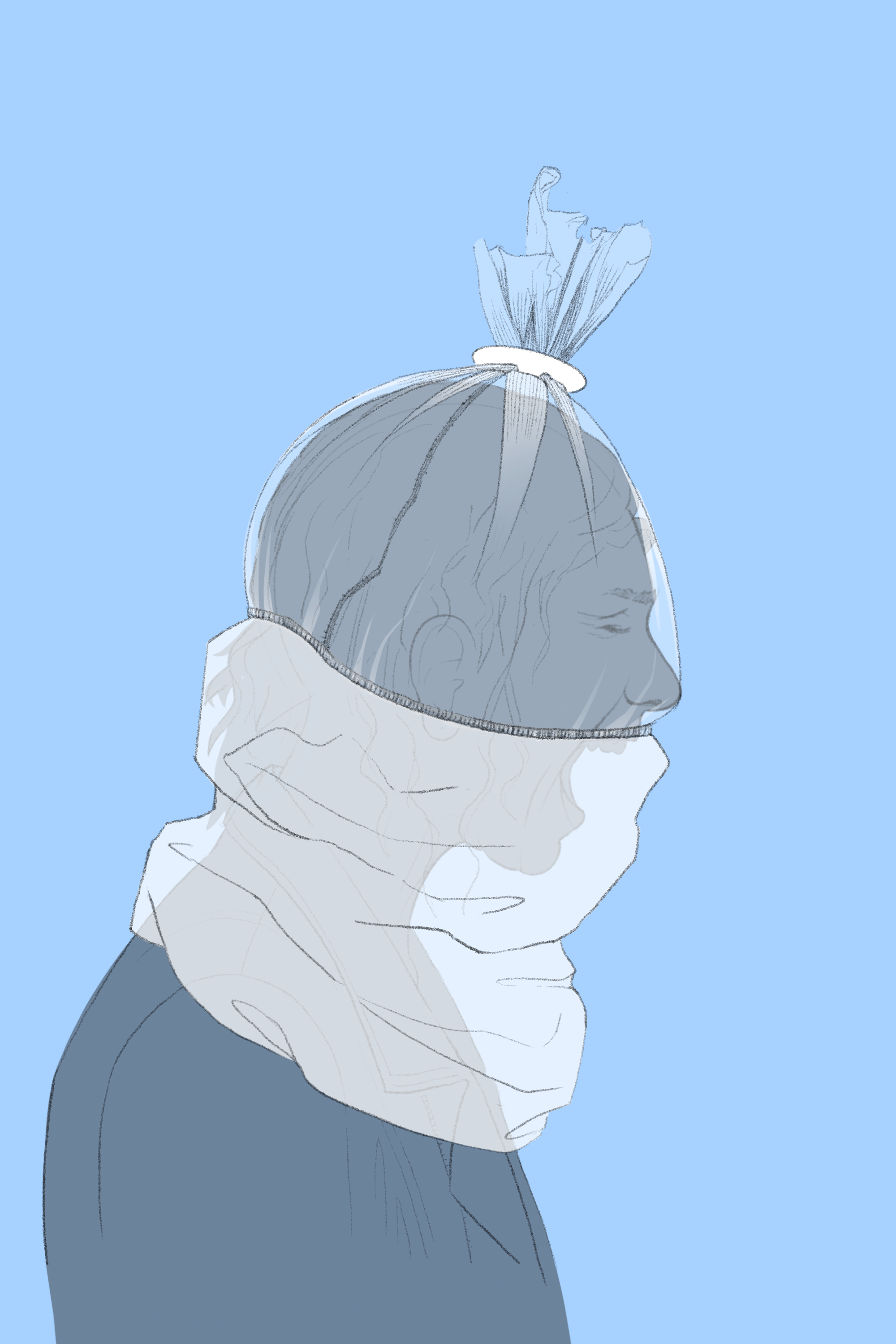
ARE SPIT HOODS SAFE?
Behind closed doors, hospital staff use spit hoods on patients with little oversight or accountability
On January 25, 2026, The Seattle Times published “Shrouded in Secrecy,” an investigative series examining the use of spit hoods in medical settings across the United States. I collaborated closely with mental health reporter Hannah Furfaro to visualize complex data and illustrate deeply sensitive, emotional subject matter.
When staff attempt to restrain a patient, some medical facilities use a spit hood—typically a mesh bag placed over a patient’s head. Experts warn that these devices can be dangerous, particularly when used outside manufacturers’ guidelines, and may lead to psychological distress, suffocation, or even death. In law enforcement settings, spit hoods have already been linked to dozens of injuries and fatalities.
The Seattle Times investigation found that spit hoods have been used in medical settings in a majority of states, often without transparency, accountability, or meaningful oversight by government regulators.
The interactive map below distills results from a national survey. Hover or tap on a state to explore detailed findings.
Medical and mental health reporting is especially well suited to explanatory and editorial illustrations. Illustrations help protect the anonymity of staff and patients, downplay unnecessary or distracting details, and focus the reader’s attention on what matters most. Illustrations are often used to communicate complex or distressing health information because they can clarify, contextualize, and reduce the visual trauma of difficult procedures—making them more accessible than raw, graphic footage.
The illustration below depicts how staff use a spit hood along with ankle and wrist restraints to control a patient in a “seclusion and restraint room” at a private mental health facility in Washington state. Circular insets draw attention to distressing moments, such as the use of a spit hood as a restraint. Care for patients in psychiatric crisis can be chaotic and, at times, dangerous. Patients may punch or kick, placing staff at risk; they may also bite or spit.

Additional illustrations underscore emotional moments throughout the story. View the scrolling versions in the Sunday mainbar, “When hospitals use spit hoods on patients, no one is watching.”





An explanatory illustration (below) compares three types of spit hoods used in medical settings.

Finally, I used Adobe After Effects to create some simple animations of the map and illustrations for inclusion in this video produced by videographer Akash Parmathy and reporter Hannah Furfaro.
Process
To develop the visuals for this project, I immersed myself in the reporting: reviewing extensive interview notes, video footage provided to the Seattle Times, manufacturers’ websites, and product warning labels. I obtained physical samples from two manufacturers, examined the materials firsthand, and measured mesh weave and dimensions to ensure accuracy in the illustrations.
The final graphics were produced using Procreate, Adobe Illustrator, Photoshop, and After Effects. Data visualizations were initially built in Datawrapper and then refined in Illustrator for print publication.
Below are a few of my early concept sketches created during the reporting and design process.