
INDIGENOUS CULTURALLY MODIFIED TREES
View the original multimedia package published in The Seattle Times on Sept. 10, 2023. This was a big project, and a team effort. I contributed 4 detailed illustrations and infographics.
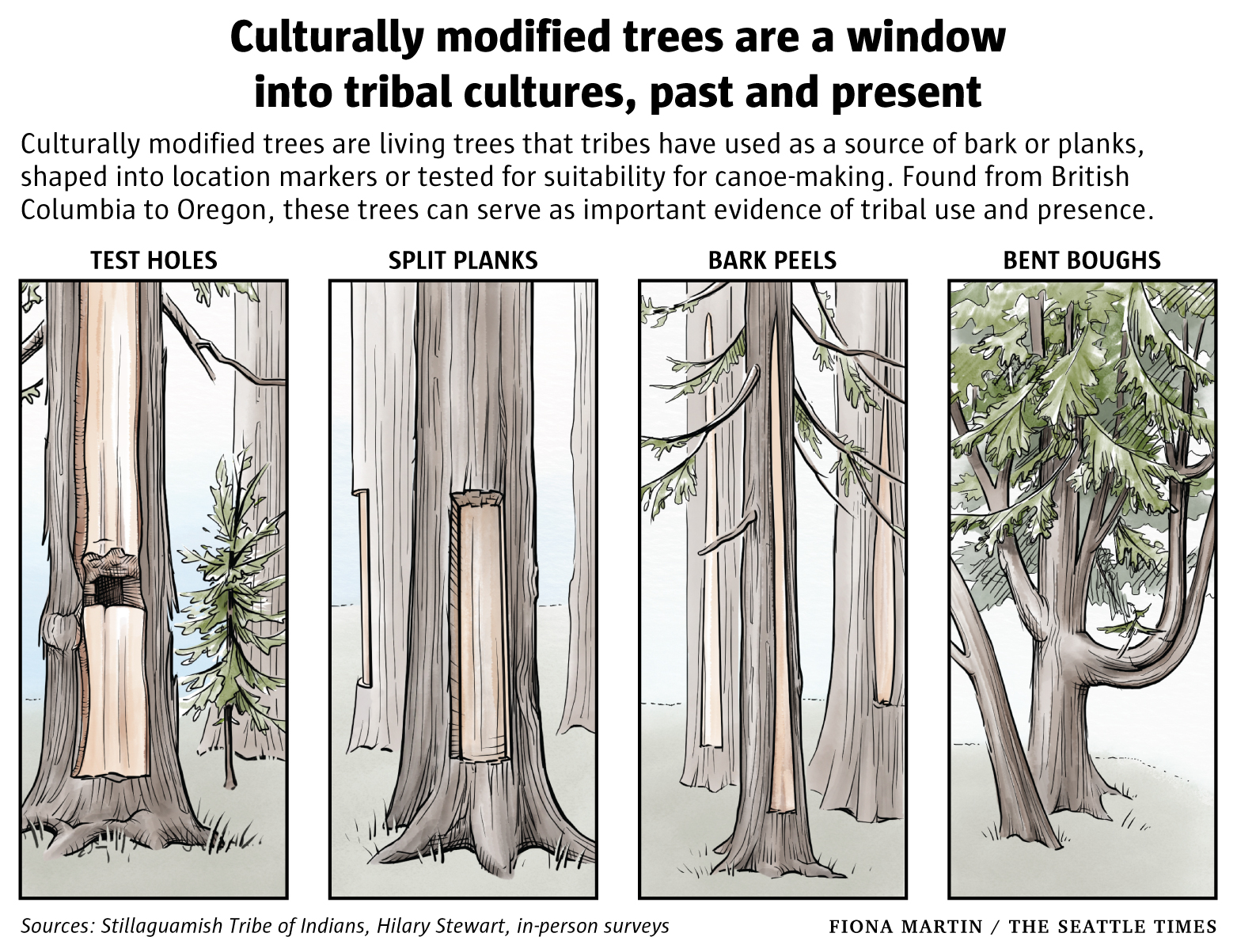
If you know what to look for, you start to notice evidence of forest cultivation by Coast Salish tribes long before Europeans arrived. Ancient western redcedars and Douglas firs bear the scars of test holes (to check for rot), split planks, or bark peels. Boughs bent at near right angles served as location markers. In the words of Samuel Barr, “we are truly living in an Indigenous garden, from which the gardeners have been forcibly removed.”

The “Tree of life” (below) describes how Salish tribes depended on all parts of western redcedar trees, including the roots, wood, bark, boughs, and thin drooping branches called withes (which have unusual tensile strength). In most cases, tribes only harvested what they needed, leaving trees standing to continue to grow, create healthy forests, and provide for future generations. What would happen if we could adopt a similar mindset? Would such long-term thinking about resource management help to create a more sustainable economy?

This promontory above Puget Sound has several Douglas firs with boughs bent at right angles. These trees were deliberately shaped by Coast Salish tribes to serve as markers of community gathering sites. They stand above a quiet cove where rich shellfish beds were once harvested. Culturally modified trees like these are found all over the Pacific Northwest, from roadsides to housing developments.

Process
Research for this story included visits to cultural sites with the reporter and the Stillaguamish Tribe. In the field, I sketched in pencil and pen, took reference photos, and visited local libraries to find books on Pacific Northwest trees, Salish culture and forestry. Some references I recommend include Cedar: Tree of Life to the Northwest Coast Indians, by Hilary Stewart, and Forest Giants of the Pacific Coast, by Robert Van Pelt, though they’re hard to find in print.
I rendered the illustrations digitally using Procreate and an Apple Pencil on an iPad.


Here’s my step-by-step process for the large western redcedar tree:
- First, I eked out a rough sketch (left) using pencil brushes, and then added some dry brushing to get a sense of shading. This process takes some “push and pull” until I’m happy with the results.
- Typically I would create a more refined preliminary drawing, but in this case I dimmed the rough sketch to 30% or so on a separate layer. Then I went straight to ink lines using a brush responsive to pen pressure (middle). In a newsroom environment, time was of the essence, and I felt confident enough that I could master the organic textures from the get go.
- Finally, I added washes of color (right).


In all, this is a very enjoyable process. I used to create around 90% of my illustrations in Adobe Illustrator using a Wacom tablet and pen tool, and still fall back on vector when I need to. Illustrator is still my finishing program for all art (including labeling, arrows, layouts, etc.). But Procreate is a great way to incorporate organic, more traditional styles. And unlike traditional media, the digital layers allow me to make changes if needed.


