
LONGVIEW PULP MILL DISASTER
Role: Visual journalist—reporting, research, mapping, explanatory graphics and science communication
Tools: Adobe Illustrator, ArcGIS, Google Earth, satellite imagery
On May 26, 2026, a chemical storage tank containing an estimated 900,000 gallons of “white liquor” suddenly failed at the Nippon Dynawave Packaging pulp mill in Longview, Washington, killing 11 workers and injuring at least eight others. The highly alkaline chemical spilled across the mill grounds with enough force to overturn pickup trucks and destroy a cinderblock wall before flowing into sumps, drainage ditches and the Columbia River. In the days that followed, thousands of dead fish were recovered, and the Washington Department of Ecology advised people and pets to avoid areas with standing water while crews worked to dilute the contamination with freshwater. Local drinking water remained unaffected.
For readers, understanding the disaster required some understanding of the chemistry behind a nearly 150-year-old wood pulping process. I first produced locator maps for breaking news, then developed next-day explanatory graphics that unpacked the kraft pulping process and the hazards of the chemicals involved.
My research drew on academic literature, pulp-industry technical materials, historical records, state and county documents, satellite imagery, and consultation with subject-matter experts.

Invented in Germany in 1879, the kraft process is still used to produce more than 80% of the world’s paper. Before paper can be made, wood chips are cooked at high temperatures in white liquor, a strongly alkaline solution that dissolves lignin while leaving cellulose fibers intact. One of the defining features of the kraft process is its efficient closed-loop recovery system, which regenerates and reuses the pulping chemicals while also producing steam and electricity that help power the mill. Because these chemicals are extremely caustic, accidental releases can pose serious risks to workers and the environment.

Because this explanatory graphic was produced for breaking news, I deliberately limited the scope to wood pulping—the stage of production where the Longview accident occurred. I did not attempt to explain the subsequent papermaking process, which introduces additional chemicals, including bleaching agents, and could warrant its own explainer.
As investigations continue, I’m researching the mill’s infrastructure, chemical processes and the sequence of events leading to the tank failure, with the goal of developing additional graphics as new findings emerge.
Understanding pH
How caustic is white liquor? Take a closer look at the pH scale. The pH scale is logarithmic, meaning each step represents a 10-fold change. At pH 13–14, white liquor is about a million times more alkaline than pure water at pH 7. It can corrode metal and cause severe chemical burns if not handled or stored safely. I created this graphic for Rebecca Moss’s investigative reporting into the chemical at the heart of the Longview pulp mill disaster. While the serious hazards of white liquor have long been known, we found it has surprisingly limited regulatory oversight.

Related
Beyond the Longview disaster, I researched the less common acid sulfite process to create a companion graphics for Conrad Swanson’s June 2026 reporting about the now defunct Cosmo Specialty Fibers mill near Aberdeen, Washington, where red liquor is suspected to be leaking from deteriorating infrastructure. A few months later, the EPA took over the site to remove the leaking acids.
The maps below (grayscale for print, satellite for online) allow readers to quickly locate the shuttered mill relative to Cosmopolis and Aberdeen. A leaking wooden pipeline runs under residential and commercial areas, connecting the old mill to a series of sludge ponds on the opposite side of town.
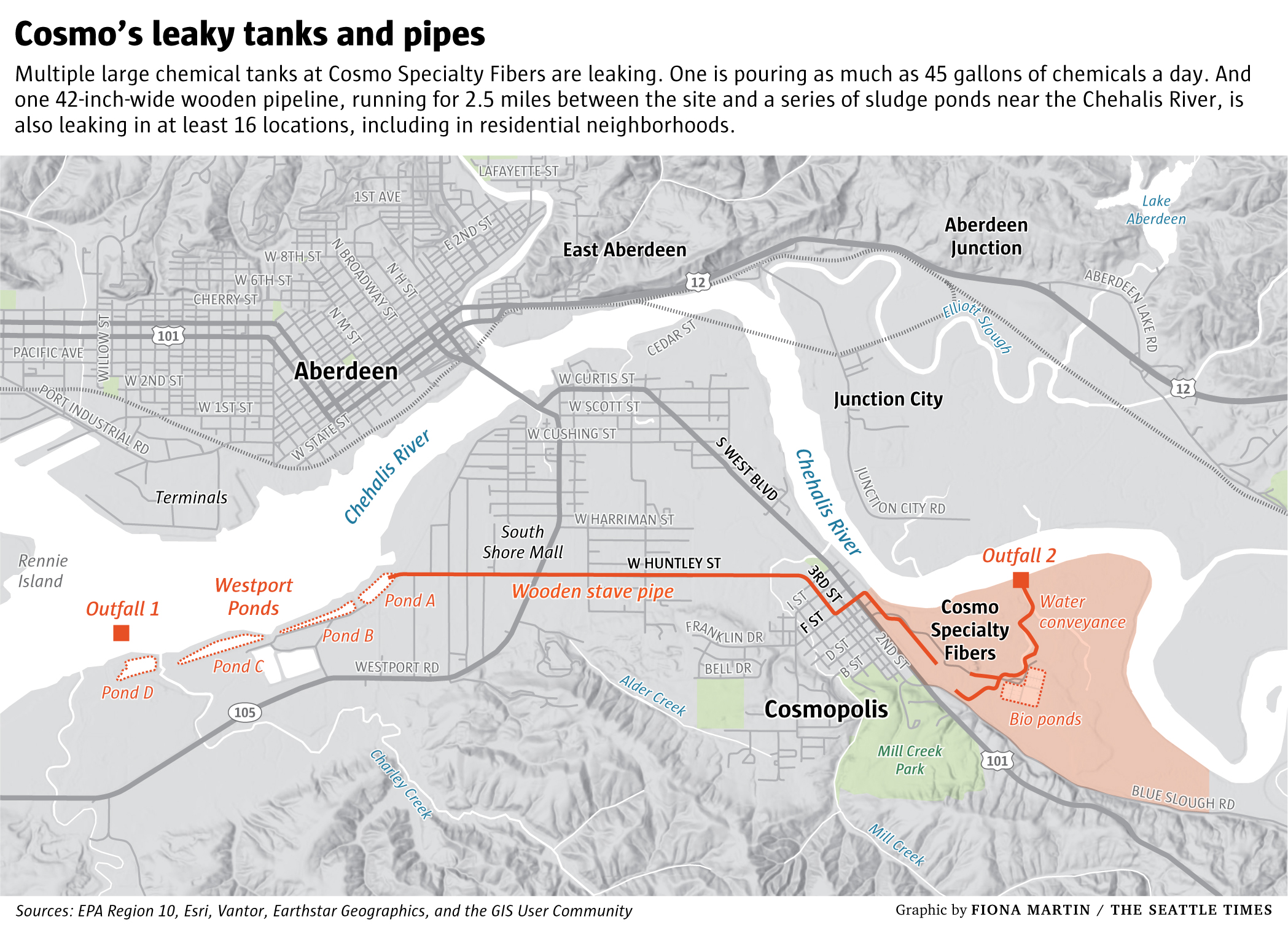
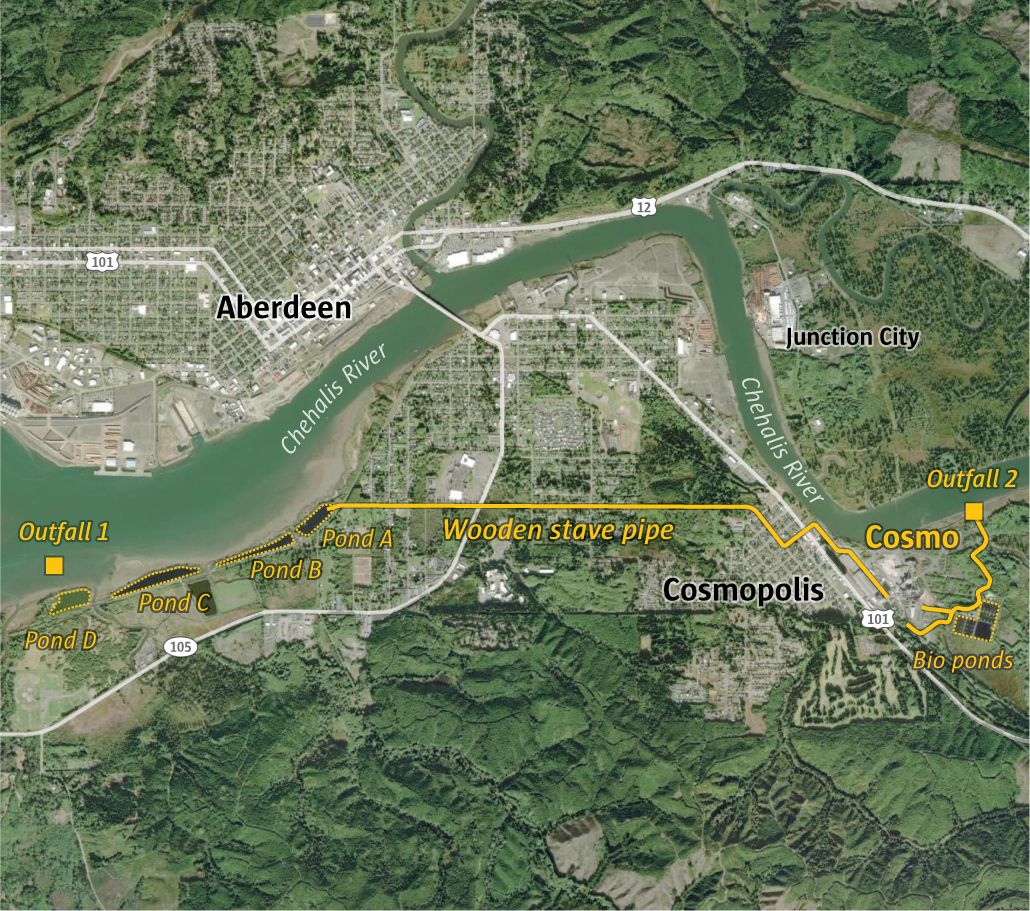
Although both the Cosmo and Longview mills were designed to process wood chips into pulp, they rely on very different chemistries at opposite ends of the pH scale. Developing graphics for each required translating two distinct industrial processes into visuals that readers without a chemistry background could quickly understand.
In sulfite mills, wood chips are digested in hot, acidic sulfite cooking liquor, with a pH somewhere between battery acid and coffee. The leftover cooking liquid, called red liquor, can be combusted in a special recovery boiler to destroy toxicants, recover some of the chemicals used in the process, and even generate electricity from steam for mill operations.


