GREEN GOLD FOR SHOREBIRDS
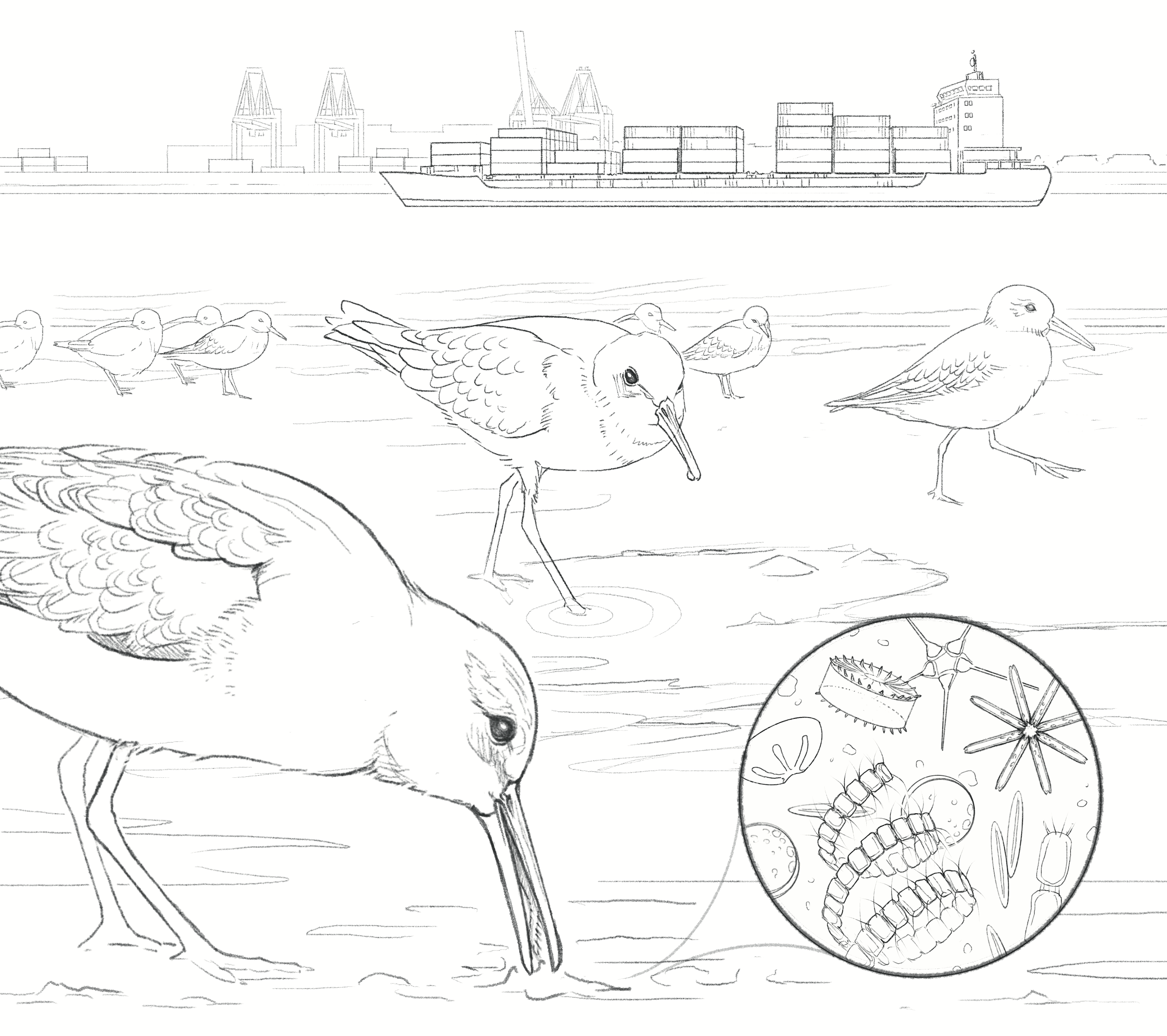
Who knew that an algal biofilm on the muddy shores of Roberts Bank could be so important? Or that marine diatoms—these silica-bound snowflakes of the sea—are capable of producing their own polyunsaturated fatty acids (PUFAs)? Neither did I, until I worked on this illustrated story with environmental reporter Lynda Mapes.

Apparently these western sandpipers are on to something. Mapes wrote, “Like the taste of oysters, silky smooth, here was an original umami goodness, not mud at all. This is the delicious fat in eulachon, or surf smelt. The yum in salmon, the lip-smacking delectable richness of crab. This was the work of diatoms by the billions, forming a frosting of nutrition-dense biofilm atop the mud.”
What do the birds know that we don’t? This is the larger question that many bird biologists seek to answer. They’re not just studying the birds, or trying to save one species—they’re trying to see the big picture. The massive expansion of a shipping port may alter currents, temperature, and salinity, thereby altering the composition of diatoms that the birds rely on to help fuel their migrations to South America and back. Many other species also rely on these diatoms, the unicellular base of the food chain.
Process
Here’s my preliminary sketch. Final art was rendered in Procreate, with annotations in Adobe Illustrator.